For anyone who gets a salary

Know exactly what you can spend today.

A budget shows what you already spent. This shows what you can spend right now — one clear number. It uses the money you have, the pay you got, what you've spent, and the bills still coming before payday.

Safe to spend today
₹95,513
We start with the money you have. We add the pay you got. We take away what you spent. We take away the bills due before payday.
Days to payday
29
Bills still unpaid
₹6,849
Spent this month
₹20,638
Left to budget
₹57,362
Instant download Works in Google Sheets and Excel 30-day money-back guarantee

You don't need to be good at money.

You don't need to know any maths. You type in six numbers. It shows you one number back.
You don't need to be organised. The file comes already filled in. You can see how it works before you add anything of your own.
You don't need to take a risk. Open it, try it for five minutes, and if you don't like it, get your money back.
The trap most people fall into

Your balance looks fine. That's the problem.

You check your bank. There is money in it. But you still don't know if you can spend it tonight. Some of that money is already needed for a bill that hasn't come yet.

01

You check the balance

It looks okay. But a bank balance is just a number. It doesn't tell you what you can spend.

02

You do the maths in your head

Take out the bills. See what's left. Split it over the days to payday. You do this again and again.

03

You're still not sure

So you spend nothing, or you spend too much and feel it on payday. Neither one is a plan.

The difference

A budget looks back. This looks ahead.

Most sheets look back at a month that is gone. This one answers a question you have today, before you spend.

A normal budget

  • Tells you "did I spend too much?"
  • You fill it in after the money is gone
  • Shows you a group that went over
  • Thinks your pay is the same each month
  • You do the math yourself
  • Often will not open in Excel

This planner

  • Tells you "can I spend this today?"
  • The number changes as you add spending
  • Shows you what is really free right now
  • Works for monthly, weekly or two-week pay
  • It does the math — you just read it
  • Opens in Excel and Google Sheets
See it working

If you look at one screen, look at this one.

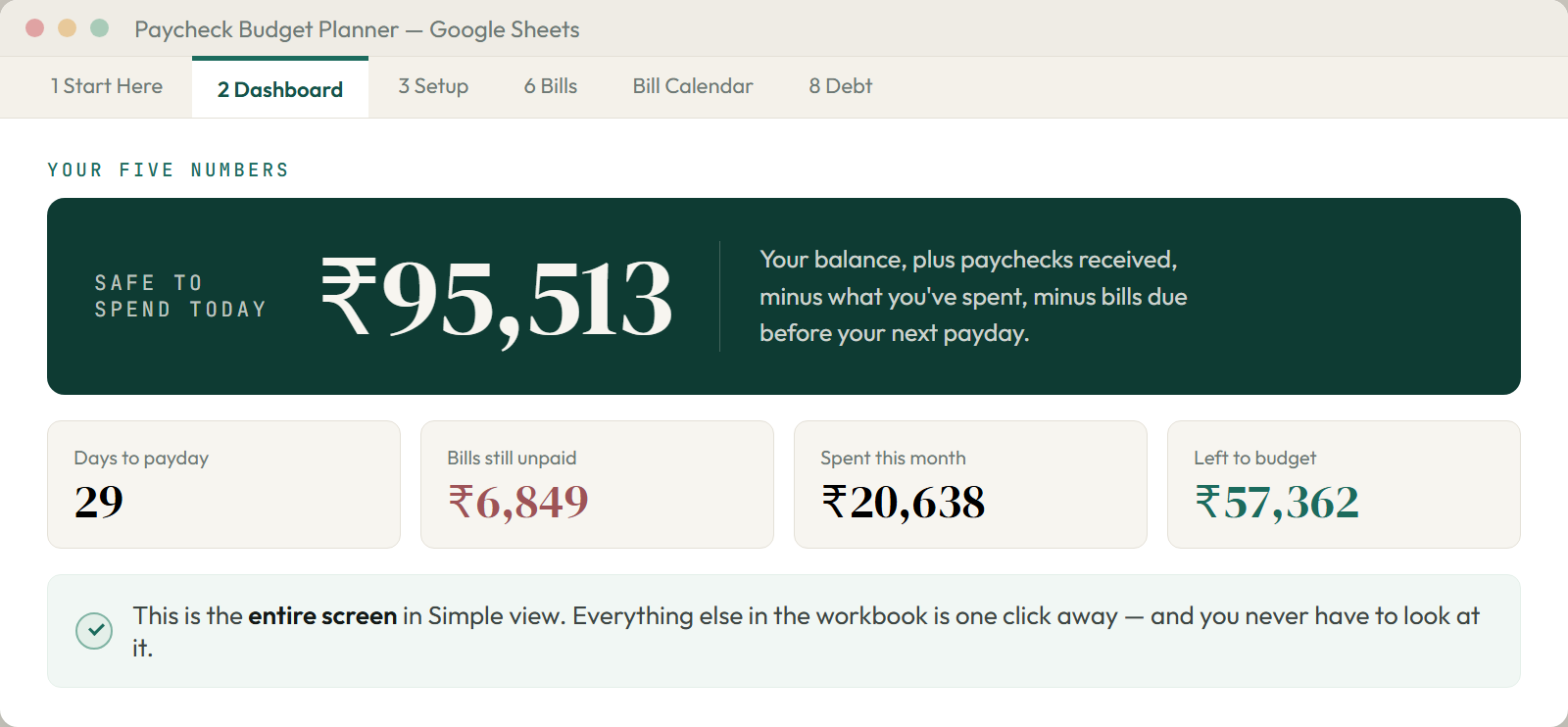
The file opens with an example already filled in. So you can watch it work before you put in your own numbers. This is the whole screen in Simple view.

The Paycheck Budget Planner dashboard in Simple view: one large figure reading ₹95,513 labelled safe to spend today, with four smaller figures beneath for days to payday, bills still unpaid, spent this month, and left to budget.
Swipe the screen to see all of it →
Simple view₹95,513 — and four numbers under it. That is the whole screen. Everything else is one click away, and you never have to look at it.

And you choose how much you see

Simple view shows one number. Full view shows the math under it too. Same file, your choice — and you can switch back and forth any time with one dropdown.

SimpleFull

Type in white boxes only

Everything that does the math is locked. You cannot break a formula by mistake. And there is no password, so you can unlock it any time you want.

Clear the example in one click

When you are ready to use it for real, set Example data to No on the Setup tab. Every sample row clears at once.

Nothing to install

Put the file in Google Drive and open it in Sheets. Or just double-click it in Excel. Both are tested.

What you get

Six questions you really ask.

Everything in the file is built to answer one of these. Nothing is there just because a money book would add it.

"What can I spend today?"
Safe To Spend, with the math shown under it. You never have to guess again.
2 · Dashboard
"What is due, and when?"
A month calendar with unpaid bills on their real dates, plus the next eight you owe.
6 · Bills + Bill Calendar
"Where did my money go?"
A breakdown by group, a monthly trend line, and your three biggest leaks named.
11 · Reports
"Which debt do I pay first?"
It ranks your debts two ways for you, and tells you how many months the first one will take.
8 · Debt
"When will I hit my goal?"
Savings goals that work out their own finish date from how much you add each month.
9 · Goals
"What if I am paid weekly?"
Change one dropdown. Pay dates, bills and monthly income all re-plan themselves.
5 · Paychecks
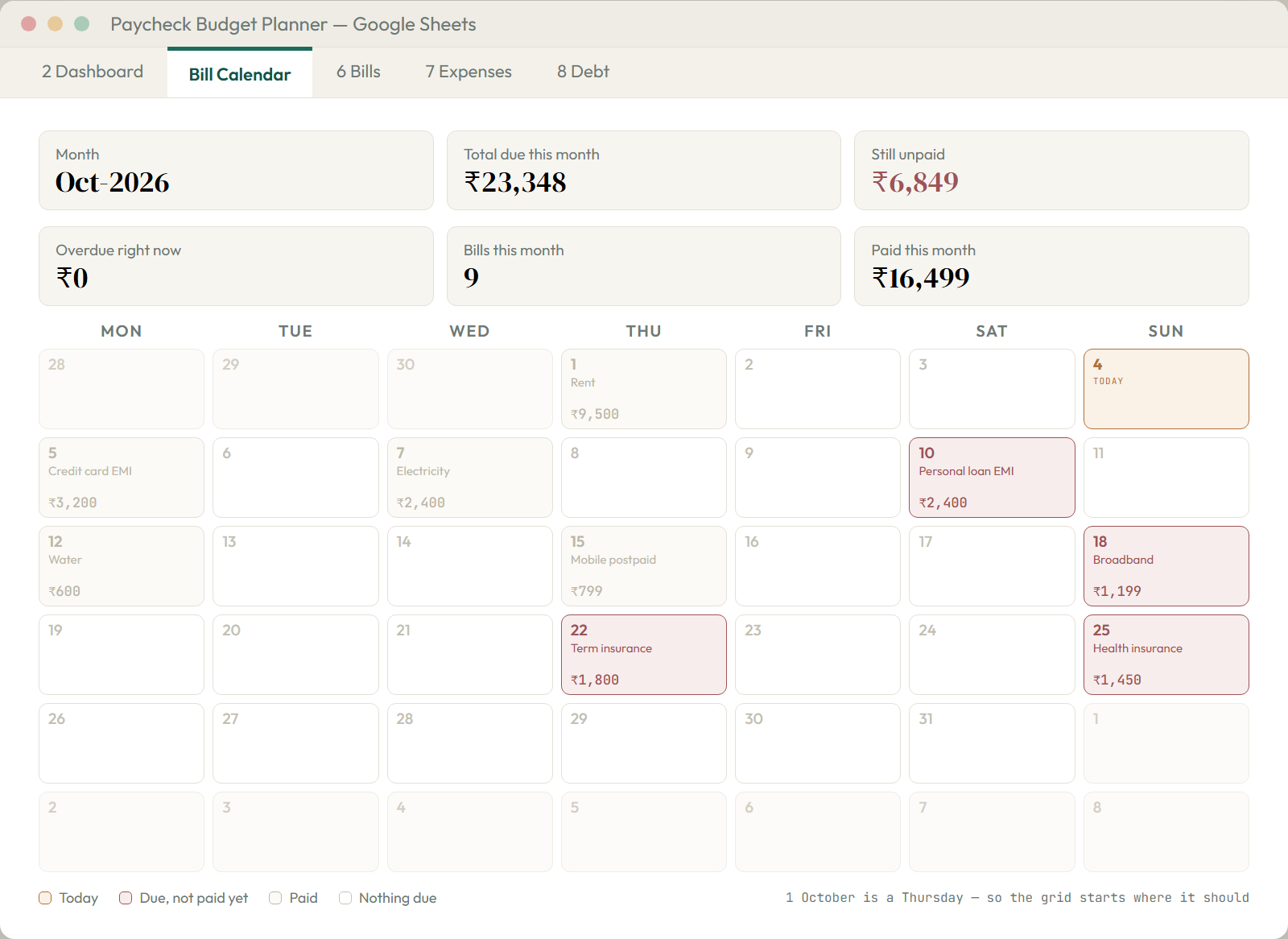
A month-view bill calendar for October 2026 showing Rent, Electricity, Water, Mobile postpaid, Credit card EMI, Personal loan EMI, Broadband, Term insurance and Health insurance on their real due dates, with paid bills faded, unpaid bills highlighted in red, and today's date outlined.
Swipe the screen to see all of it →
Bill CalendarEvery bill sits on its real date, not a set "day of the month". The 4 rose cards are the bills still unpaid — and marking one paid moves the safe-to-spend number right away.
Which debt first

It tells you which one to pay first. Then it counts the months.

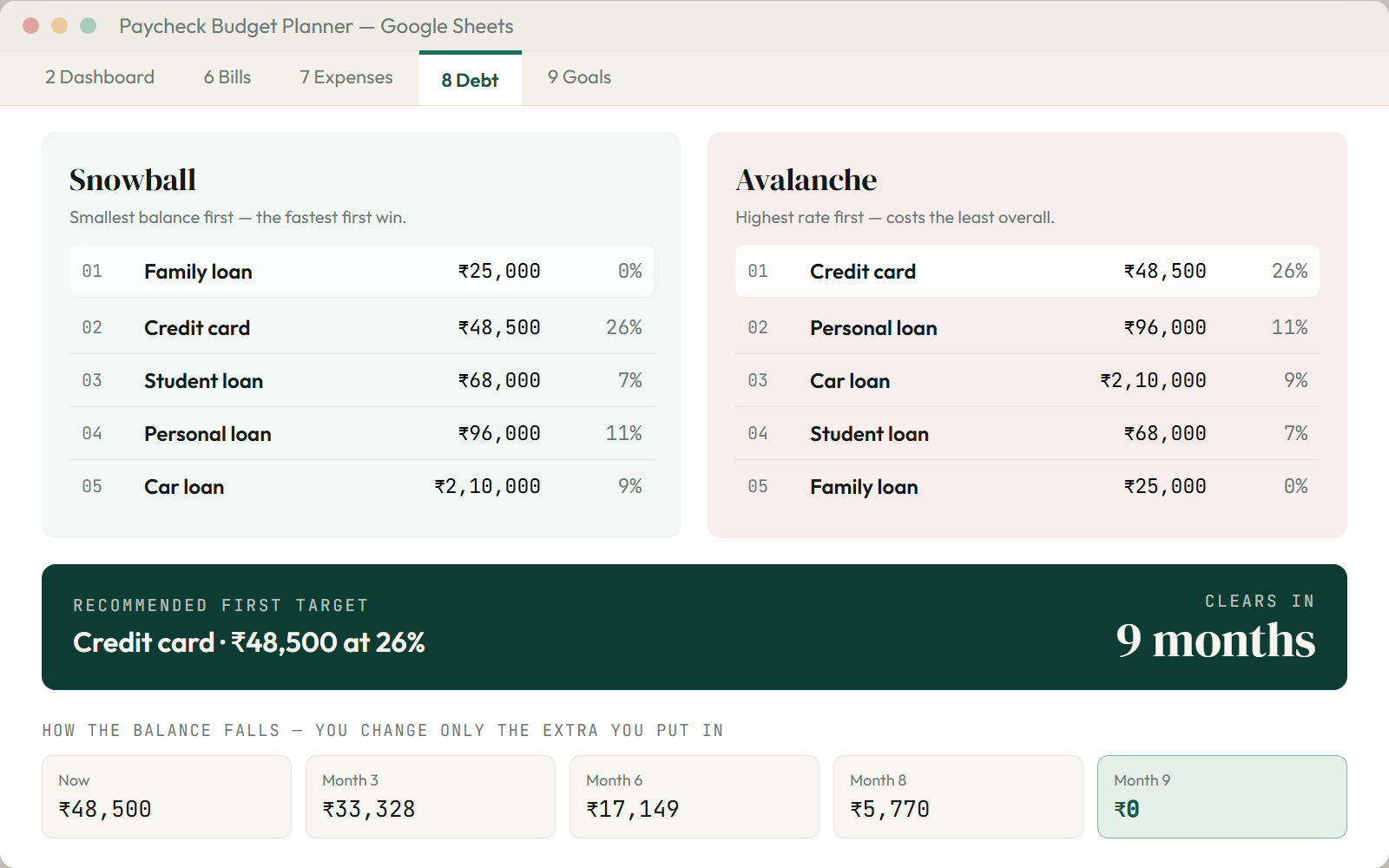
Put in what you owe and the rate. The file ranks your debts two ways — smallest first, and highest rate first — and works out how many months the one it picks will take to clear with the extra you pay.

Two ranked lists of five debts side by side: snowball ordering by smallest balance first with family loan at number one, and avalanche ordering by highest interest first with Credit card at 26 percent as number one, and a verdict that the Credit card at 26 percent is the first target and clears in 9 months.
Swipe the screen to see all of it →
Debt tabIt ranks both ways, then picks one and shows the balance drop month by month. Here it picks the Credit card at 26% — which clears in 9 months — and shows you the whole path, not just the first step.
Setup

Three minutes. Six numbers.

No formulas to learn. No empty grid to stare at. It opens already working.

1

Fill in six boxes on the Setup tab

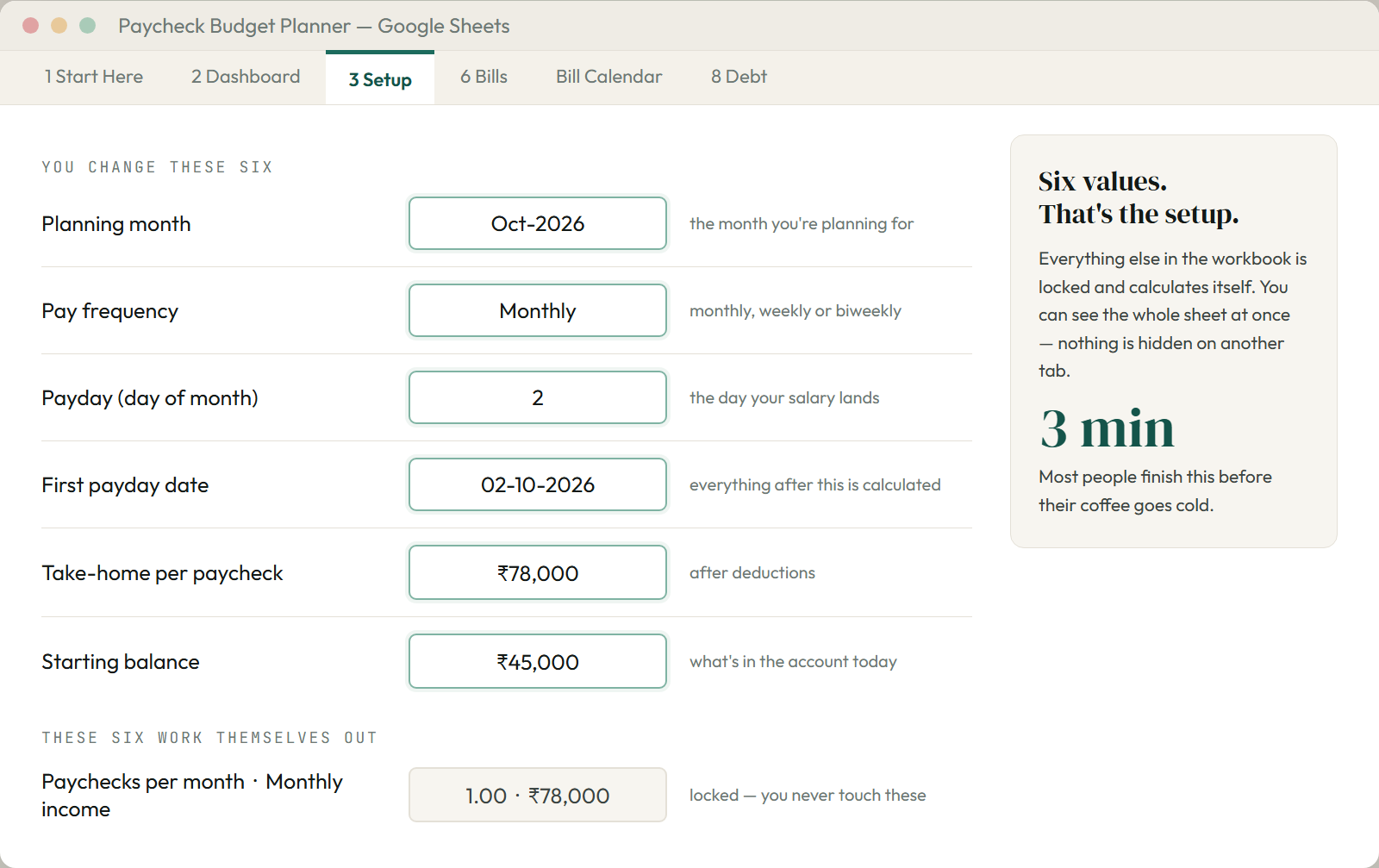
How often you are paid, your payday, your next payday, your take-home pay, your starting balance, and the month you are planning. Everything below that works itself out — you never touch it.

2

Read your number

The Dashboard shows Safe To Spend at the top and four more numbers under it. Switch it to Simple and that is the whole screen — nothing else to learn.

3

Add your bills, then your spending

It comes with an example so you can see it work first. When you are ready, set Example data to No on the Setup tab and every sample row clears at once. Then just type.

The Setup tab showing six input boxes — planning month, pay frequency, payday, first payday date, take-home per paycheck and starting balance — with two calculated figures below and a note that everything else is locked.
Swipe the screen to see all of it →
Setup tabSix boxes, and that is the whole setup. Everything below them is worked out and locked, and you can see the whole sheet at once — nothing is hidden on another tab.
If you like knowing how it is built

How it is built, if you care.

You do not need any of this to use the file. But if you have bought a sheet before that broke the moment you typed in it, these are the numbers I would want to see.

13
Tabs, each with its own job
Start Here, Dashboard, Setup, Budget, Paychecks, Bills, Bill Calendar, Expenses, Debt, Goals, Annual, Reports and Categories. No filler, no repeats.
1,248
Formulas, run again and read back
Every one was checked after a full redo of the math, in Excel and in LibreOffice. 0 came back as an error.
0
Repair pop-ups in real Excel
It was opened in Excel itself, not just made. It loads clean, with no "we found a problem" box.
1,234
Cells you can type in
Everything else is locked — and the lock has no password, so Review > Unprotect Sheet opens it right away if you want to change something.
36
Named ranges, so renaming is safe
The math uses names like SafeToSpend, not cell numbers. Add a bill on any row and nothing else breaks.
0
Macros or add-ins to turn on
No yellow warning bar, no "enable content" step, no .xlsm. It is a plain file that opens like a plain file.

This part sits down here, not at the top, for a reason: none of it helps you decide to buy. It just helps you stop worrying that the file is weak. If you would rather skip it, go to setup — it takes three minutes.

Against the other choices

There are free sheets for this too.

There are. Here is the honest side-by-side, including where the free one wins.

  This planner Most paid sheets Free Google / Canva sheet
Tells you "what can I spend today?" Yes — that is the whole pointNoNo
Opens in Microsoft Excel Yes — tested in bothMost don'tNo
Real due dates, not day-of-month Yes, DD-MM-YYYYSometimesNo
Works for weekly / two-week pay Yes, 52 paychecksRarelyNo
Ranks which debt to clear first Yes, both waysNoNo
Made for ₹ / UPI / card EMI Yes, ready to goNoNo
Comes with an example filled in YesSomeNo
Formulas locked from mistakes Yes, no passwordSomeNo
Look and feel CarefulVery mixedUsually rough
Price ₹299₹78–₹331Free

Where the free one wins: it costs nothing, and if you only want to track one thing, it is really enough. This is for the person who has tried that and ended up back where they started.

Before you decide

Every number on this page came from the file.

Not from a spec sheet I wrote months ago. This page is built from the file itself. So if a number here did not match what you see when you open the file, that would be my mistake — and you could prove it in under a minute.

13
tabs, each with its own job
1,248
formulas, run again and read back
0
came back as an error after that re-run
1,234
cells you can type in — the rest are locked

I also opened it in real Microsoft Excel, instead of just trusting that a tidy file is a working file. "It opens" and "it opens with no repair pop-up" are two different things. The bill calendar is checked against the real weekday of every date across fourteen months. So the 1st lands under the right day whichever month you pick.

And there is no review on this listing yet, because it is new. I am not going to make one up, or hint at sales I do not have. So judge the file instead — it is yours in three minutes, and if it does not give you a clearer answer than the one you had this morning, you get your money back.

The part most listings hide

There is one small job each month. Here is how small.

Your bills use real dates, not a fixed "day of the month". So they need to be moved forward each month. That is the honest cost of being exact: a bill on the 31st does not fall on the 31st every month, and a one-time charge should land in the month it is really due.

It takes about thirty seconds. Move Planning month forward on Setup, paste this into any empty column on the Bills tab, and drag it down:

=IF(F5="No",DATE(YEAR(D5),MONTH(D5)+1,MIN(DAY(D5),28)),"")

Copy the results and paste-special values back over the Due date column. Paid bills skip themselves. The MIN(DAY,28) part stops a 31st bill from breaking in a short month. Every total, chart and your Safe To Spend number updates itself.

What you are getting

Everything in it, priced honestly.

Every line below is something you would otherwise have to find, build, or talk yourself into.

Simple view — one number on screen, no sheet to read
₹499
Paycheck engine — monthly, weekly or two-week pay, 52 paychecks planned
₹399
Bill calendar — month grid plus your next eight unpaid bills
₹299
Debt ranking — both ways, worked out for you
₹299
Excel version — no Google account needed
₹299
Auto dashboard — charts that redraw as you add spending
₹399
7-page start guide — with pictures, in plain English
₹199
India pack — ₹, UPI, card EMI, DD-MM-YYYY, school fees
₹149
One-click example clear — the sample clears in one click
₹149
Free updates for life — every fix I make from here on
₹199
Total value
₹2,890
Launch price
₹299

About the cost of one takeaway dinner — and about one second of your monthly pay. It will either tell you what you can spend this month, or it won't.

Get the planner
Your questions

The things you would ask me anyway

Isn't this just a free budget sheet?
It could be, if you only want to track a few things. A free sheet does that fine. The difference is what it answers. Those ask "did I spend too much?" after the money is gone. This asks "what can I spend right now?" while you still have a choice. If that second one is your problem, a free sheet will not fix it.
Why not just use Google Sheets on my own?
You can — this is a Google Sheet. What you cannot do in a blank sheet is get to the number. That means building the math, setting up the groups, and keeping it right when you add a bill. That is your whole weekend. This is that weekend, already done.
I don't have Microsoft Excel.
You do not need it. Put the file in Google Drive, right-click, Open with Google Sheets, and it all works. Excel works too, for the people who want it. It is not a must.
What if I am not good at spreadsheets?
You only ever type in the white cells. Everything that does the math is locked, so you cannot break a formula by mistake. And there is no password, so if you want to unlock something, Review > Unprotect Sheet does it right away. The seven-page guide walks you through it with a picture of every screen.
Will it work if I am paid weekly?
Yes. Set Pay frequency to Weekly on the Setup tab. It builds out 52 paychecks for the year, matches each bill to the right payday, and works out your monthly income. Two-week pay works the same way.
Is it really ₹299?
The full price is ₹349. ₹299 is the launch price while this is new, so the discount is real, not made up. It goes up once the listing is no longer new.
What if it just doesn't help me?
Email me within 30 days and say so. You get a full refund. No forms, no questions, and the file stays yours either way. I would rather refund ten people than keep one quietly unhappy one.
Try it for 30 days.

If it did not give you a clearer answer than the one you had before you opened it, email me within 30 days and I will refund you in full. No forms, no reason needed. The file stays yours either way.

Get it — ₹299
Start here

Find out what you can spend today.

About three minutes between you and a number you can trust. It works in Google Sheets and Excel, and it comes already showing you how it works.

Get the planner — ₹299

Instant download · Works in Sheets and Excel · 30-day money-back guarantee